
Red List celebrity
Godrevy and St Gothian Sands Nature Reserve, Cornwall

Migratory birds will be thinking about returning to the UK now, if they haven’t already taken flight. While they run like clockwork, I do not. I’m writing about it now, but this walk took place when the birds were leaving last year. Early October, I think. Might have been September.
It’s August 1st, 2012, and in Shetland a red-necked phalarope is doing the bird equivalent of double-checking that the TV is unplugged, the cooker is off and the back door is locked.
He shakes his feathers, stretches his wings, has one last look around and then sets off for a six-day flight across the Atlantic Ocean.
He’ll rest and refuel in the Labrador Sea off Canada before taking an aerial road trip down the east coast of North America to Florida.
There, he’ll make a sharp right turn and cross the Gulf of Mexico to spend six months bobbing around in the Pacific, between South America and the Galapagos Islands1.
What he won’t do is leave Shetland and take a 600-mile detour south-west to visit a small nature reserve nestled behind the dunes at a Cornish beach.
Celebrities visiting Cornwall can easily go unnoticed. You might nod a friendly good afternoon as you pass someone on the coastpath and after a few moments wonder aloud: “Wasn’t that the guy from that thing we used to watch on Sunday nights?”
The bunch of long lenses were a dead giveaway though. There was no flying under the radar for this celeb. The paps had found them.
So, having already completed a circuit of Godrevy headland, with its grey seals and oystercatchers, we extended our walk to the lagoon at the St Gothian Sands nature reserve to find out who the attraction was.
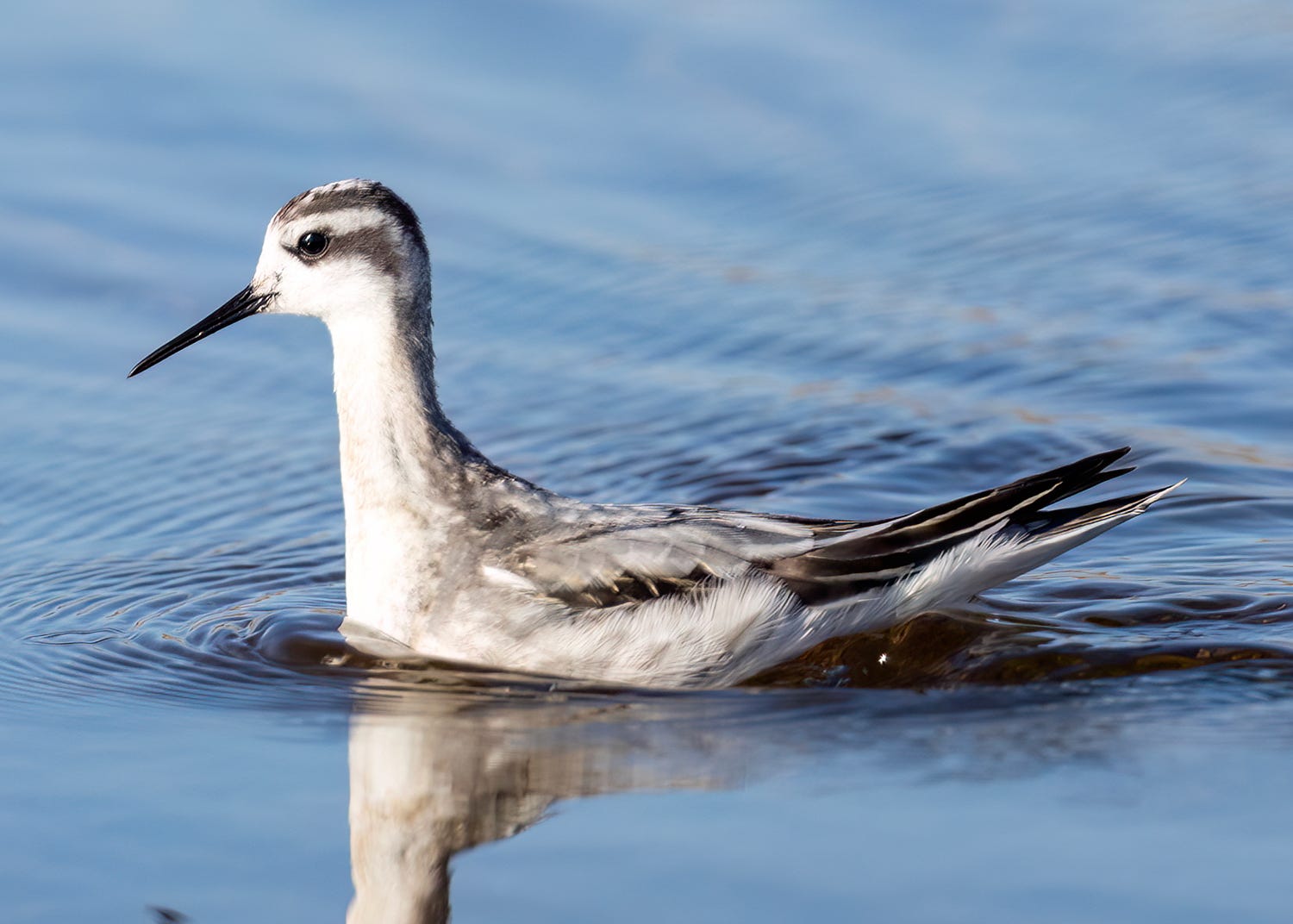
They had done their best to blend in with the masses, shedding their trademark red scarf for the shades of white and grey favoured by the black-headed gulls who are regular visitors to these parts. But you don’t get many like this little wader these days, so they were unlikely to stay out of the spotlight.
Never mind A- and Z-listers, the red-necked phalarope – pronounced, disappointingly if you ask me, like antelope, not Penelope – is a Red List celebrity2. There are thought to be fewer than 100 breeding pairs in the UK – all in Scotland, most in Shetland. We were reliably informed that this was the first recorded in Cornwall.
It’s not clear why they had taken this detour. Blown off course in a storm, perhaps. Cutting out the Canada leg of the grand tour, possibly. Red-necked phalaropes spin around like an Olympic figure skater to create a whirlpool that brings food to the surface of the water – so maybe they were just dizzy.
Had it not been for the birders, I would probably have written them off as just another black-headed gull in winter gear3.
Sorry if that sounds rude, but it doesn’t feel half as rude as the Wildlife Trusts’ description of phalaropes as “a strange group of pot-bellied, long-necked, short-legged, needle-billed waders”.
The red-necked phalarope can, however, boast a near 1000-word entry on Wikipedia, while St Gothian, on whose nature reserve this bird has chosen to alight, is simply on the end of this burn: “Nothing is known about St Gothian.”
Not strictly true. He is thought to have been among hundreds of sixth-century Irish missionaries who landed at nearby Hayle and were assumed to be invaders by Teudar, the king of Cornwall, and killed even before being asked for any form of ID.
Our red-necked phalarope received a much friendlier welcome. But why did this Red Lister come to Cornwall? Save it for the autobiography.
Basking sharks seen on this walk: 0
Total basking sharks seen to date: 0
Before this bird’s migration was tracked by a battery-powered tag strapped to his back, it had been assumed that Shetland’s red-necked phalaropes had headed in the opposite direction for their winter migration, joining their Scandinavian cousins to winter in the Arabian Sea.
The Red List contains the birds whose conservation status in the UK is of most concern.
A closer look would have told me they were much smaller and that rather than a sooty smudge on each ear, they had streaks of black mascara across their eyes.
How exciting to see a Red Necked Phalarope in Cornwall. We've been to Shetland twice and twice made the pilgrimage to Fetlar to see them. The first time no luck, the second time we started at the loch where they hang out, nothing there, so we walked all round the island and back to the loch. We'd just about given up hope and had a ferry to catch so gave a last look round the loch and a female Red Necked Phalarope appeared from the rushes and we spent a couple of lovely minutes with her.
Enjoyed the read. The last one I saw was on Fetlar a few years ago. We did have a grey phalarope on the Norfolk coast this year though.