
A suspicious case
Porthtowan beach, Cornwall

At the back of Porthtowan beach is a small, squat, square building. A row of black wheelie bins are lined up behind, patiently waiting to be fed with poo bags and cider bottles.
Along with the surf lifesaving clubhouse next door, it has been carefully cropped out of aerial photos promoting the recently built holiday let (£13,595 for seven nights in August) that looms over them and looks like a solicitors’ office on an out-of-town trading estate.
You’d be forgiven for thinking the small, squat, square building was a storage shed for the lifeguards. Particularly since it’s been wrapped in a colourful surfing-themed mural.
But this is Porthtowan Beach No 1 pumping station, whose job it is to take away whatever the villagers and holidaymakers flush down the toilet.
Sometimes, particularly when it’s been raining heavily, it’s not up to that job and will discharge the overspill into the stream that runs across the beach and into the sea (16 times in 2025 for a total of 159 hours).
South West Water commissioned an artist to paint the mural. Proving you can polish a turd – as well as flushing it into the sea.
I should say that Porthtowan Beach No 1 is far from No 1 in the list of worst offenders1 and the beach has Blue Flag status. But this kind of thing can make you a bit suspicious of stuff you find in the sand. Like this rubbery crescent.
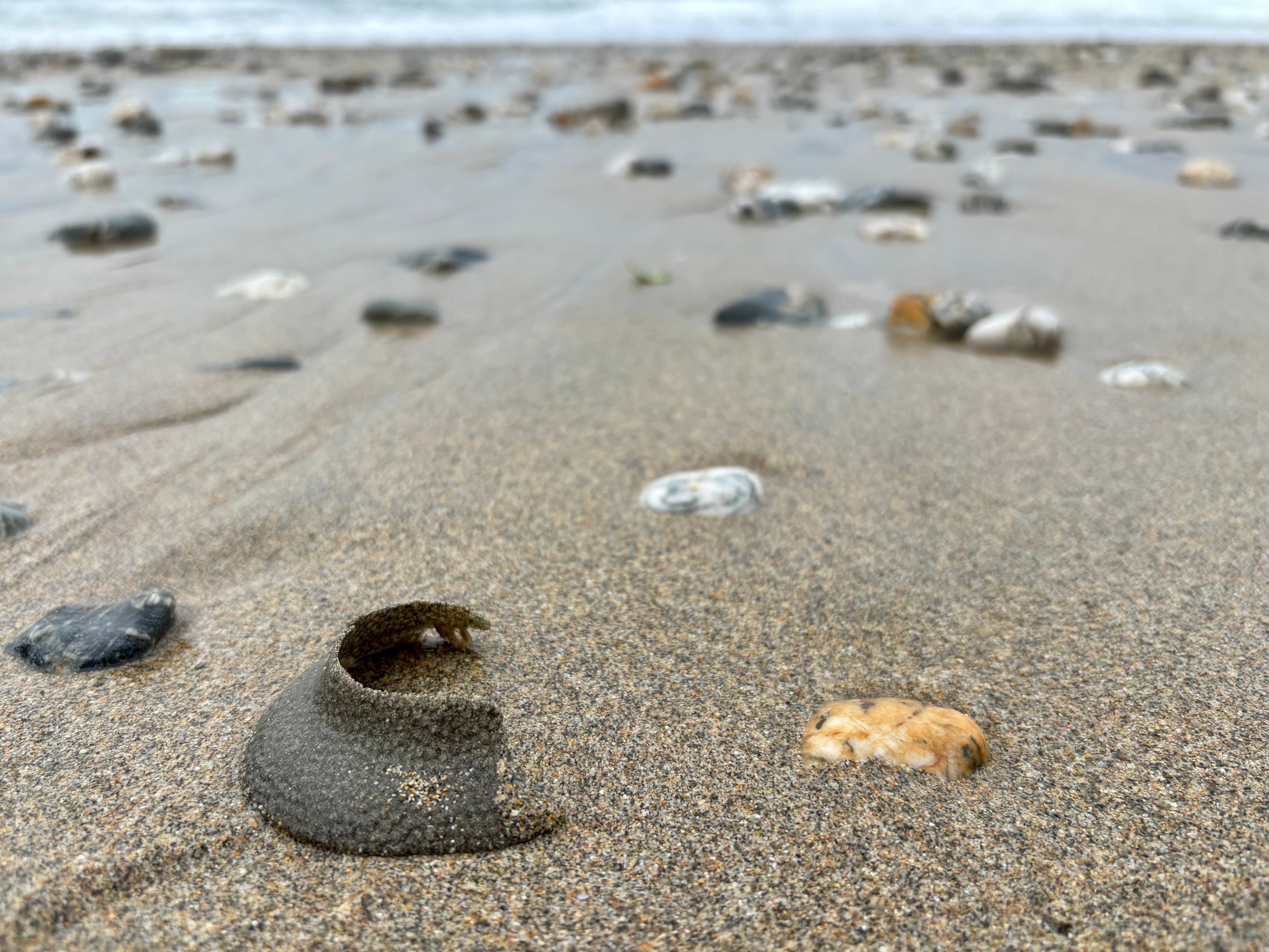
Grey and pimpled, it has the look and texture of the dashboard in my car, but it’s as flexible as the seatbelts.
People have been gathering piles of them during beach cleans, convinced they’re just another piece of beach litter like the shards of plastic, knots of fishing rope and Maoam wrappers (always Maoam wrappers).
But rather than bits of old shoes or the insides of tennis balls, what they’ve actually been collecting are the remains of moon snails’ egg cases.
The moon snail is a predator that feeds on other molluscs in the way some people eat a Creme Egg – nibbling a hole in the top and sucking out the goo2.
That’s not the only sticky business moon snails get involved in. Females lay their eggs in a halo of mucus around themselves. When sand mixes with the mucus, it takes on a rubbery consistency and forms what is known as a sand collar.
Once the baby moon snails have hatched, the sand collar disintegrates and the remains wash up on the beach.
So, at the stage we find them, they are a waste product, but an entirely natural one.
That means this half-ring of ‘rubber’ can stay in the sand. That Maoam wrapper, though? That’s going in the bins behind Porthtowan Beach No 1 pumping station.
Basking sharks seen on this walk: 0
Total basking sharks seen to date: 0
Looking at you Portreath, a few miles down the coast, with 134 spills totalling 2332 hours in 2025 – more than a quarter of the year.
They’re assisted by a radula – a kind of toothy tongue – and some acidic enzymes. Neither of which are necessary for eating a Creme egg.
Fascinating! (The rubbery snail collar, not the occadional river of shit, which is, alas, rather familiar)
How much for a holiday let? I think I should type that in capitals. Criminal.