
A supreme athlete
North Cliffs to Hell's Mouth, Cornwall

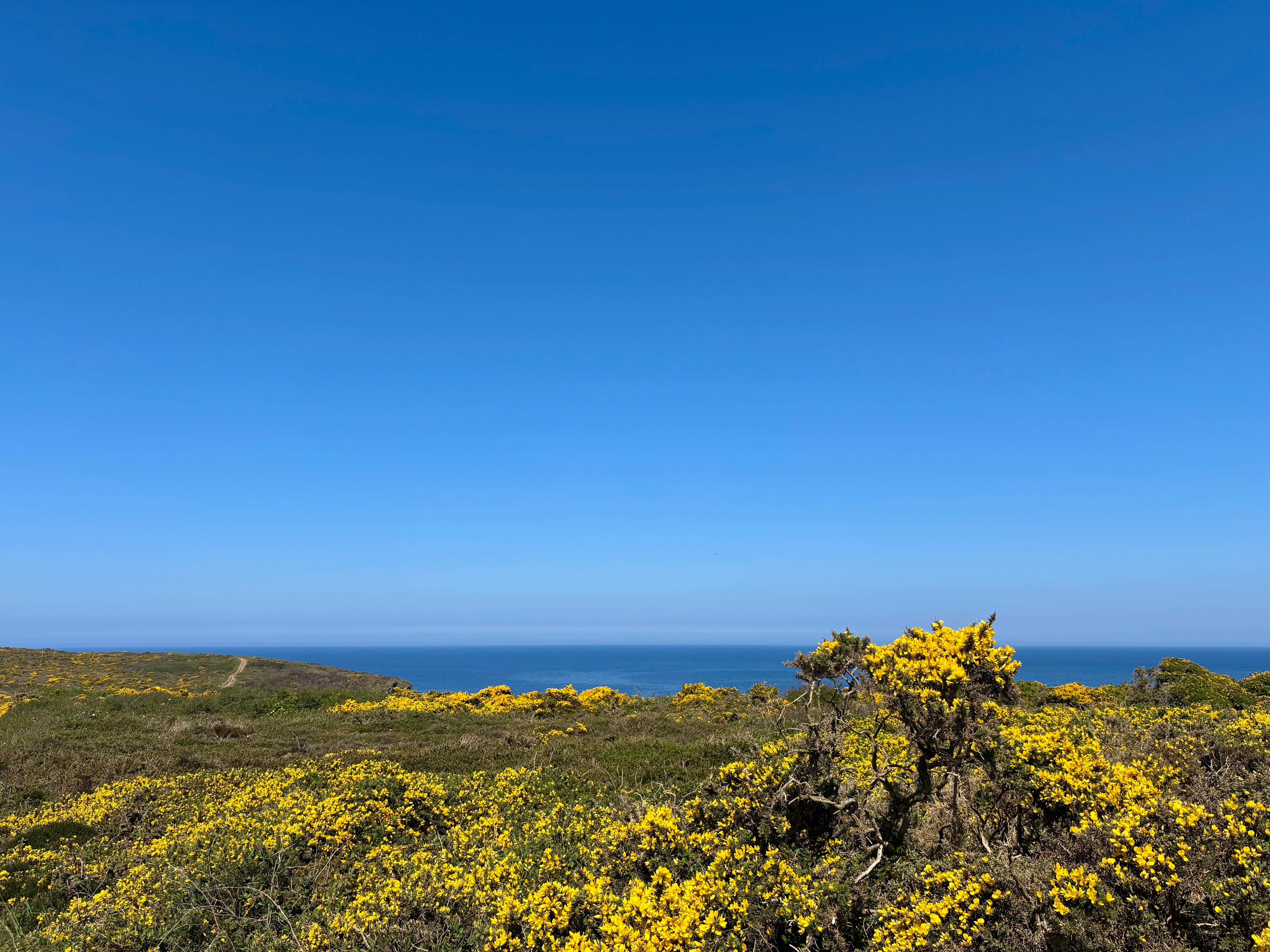
I make it back to my clifftop starting point with an hour to spare before nursery pick-up.
Dropping my bag and body to the ground, I congratulate myself for booking today off work.
It’s the perfect day for a stomp on the coast path. The kind of day that isn’t as common on the north coast of Cornwall as people think. Warm sunshine, a cloudless sky, a gentle breeze.
Settling into a thick cushion of grass, I listen to a skylark ascending, a bumblebee descending and the sea tickling the rocks in the cove below.
I set an alarm on my phone. Just in case.
I stretch out my legs then draw up my knees, fold my arms then rest them by my sides, unsure what to do with all my limbs.
A St Mark’s fly bounces off my head.
With hunched bodies and long legs dangling, like a giraffe in a ski lift, I identify more with these clumsy, gangly insects than the supreme athlete that’s about to jolt me from my doze.
It arrows into view from my left. A grey lightning bolt that drops at almost 90 degrees into the cove. Re-emerging a few seconds later, it sweeps to the far side, completes a couple of loops and flies into the cliff.
I sit up and grab my binoculars, scanning the rockface until I find the bird perched on a grassy ledge.
Daz-white collar, Tesco value washing powder-white shirtfront, bright yellow feet and dark grey wings and hood. A peregrine falcon.
It stands proudly on its ledge, confident in its body. A body built for speed: from stiff feathers for streamlining to a membrane that protects the eyes from rushing air in 200mph dives to pluck other birds out of the sky.
Like all supreme athletes, peregrines are exploited by people who want to make money.
Falcon racing is a lucrative business in the Middle East, where the best birds are treated like elite footballers – transported in luxury vehicles and bought and sold for big money.
With our cooler climate thought to make them tougher and speedier, British peregrines and peregrine hybrids are the star signings. And that has led to a boom in breeding facilities, of which there are now more than 150 in the UK, exporting thousands of birds every year.
If that sounds iffy enough, while being legal, this is where it gets really murky.
Wild birds are naturally – in every sense – fitter and faster than those bred in captivity. And some people will stop at little to cash in on that.
An investigation by The Guardian and Arab Reporters for Investigative Journalism revealed RSPB data showing that between 2014 and 2023 there were 126 reports of chicks being taken from peregrine nests – a breach of the Wildlife and Countryside Act and, well, just plain wrong. Of those, 21 were confirmed, with the belief that all were linked to the trade in peregrines for racing. It’s likely this involved the chicks being laundered through ‘legitimate’ breeding facilities.
Only once do I and the peregrine break our vigils, disturbed by a commotion among the gulls as a huge bird sails across the cove and directly over my head, its long, fingered wings stretched out like a gymnast at the end of their routine. I’m familiar with red kites from visits to family in Berkshire, but they’re a rare sight in Cornwall. A flock comes for a spring break every year but they’re yet to make a permanent move here.
The peregrine again completes a couple of loops before settling back on its grassy ledge. I settle my elbows back on my knees, binoculars raised to my eyes.
I can’t hold this position for long before my arms begin to tremble.
The alarm on my phone goes off.
I hit snooze and stretch out my legs.
A St Mark’s fly bounces off my head.
Basking sharks seen on this walk: 0
Total basking sharks seen to date: 0
I've not seen a Peregrine for a while now, used to see them quite regularly here around Edinburgh. Amazing birds.
Amazing to see a peregrine!